Segmenting your cold email list by engagement levels is a smart way to improve campaign performance and protect your sender reputation. Instead of sending generic emails, group your contacts into cold, warm, and hot prospects based on their interaction with your emails - like opens, clicks, or replies. This approach increases relevance, boosts open rates by 14.31%, and doubles click rates by 100.95% compared to non-segmented campaigns.
Here’s a quick summary of how to do it:
Steps to Segment Your List:
Key Metrics to Track:
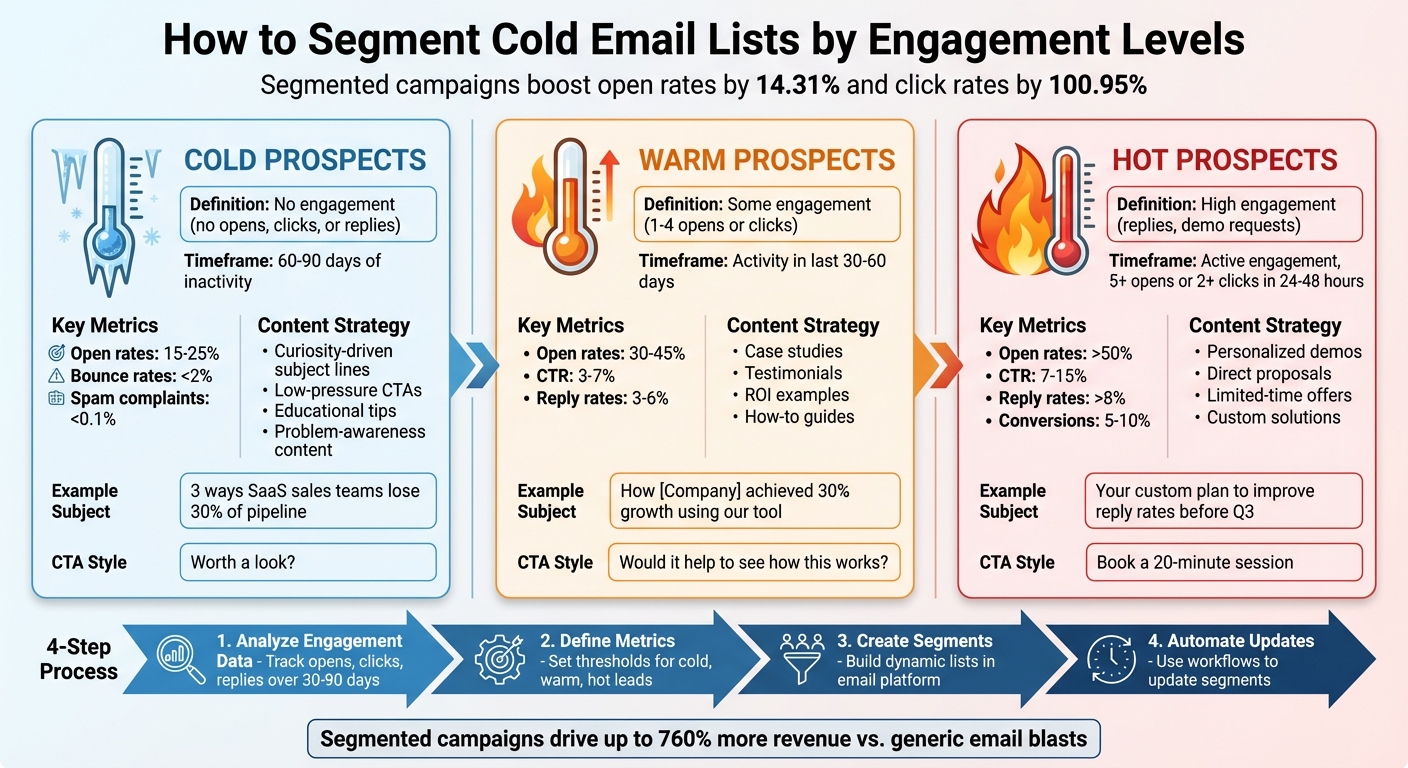
Cold Email Segmentation: Engagement Levels, Metrics, and Content Strategy Guide
To effectively segment your outreach list, you need to understand the different levels of engagement. Cold, warm, and hot prospects represent varying degrees of interest and readiness to take action. Each group has unique behaviors and requires a tailored approach to maximize your chances of success.
Think of these levels as steps on a ladder. Cold prospects are at the bottom, showing no interaction. Warm prospects are climbing, with some engagement like opening emails or clicking links. Hot prospects are at the top, actively engaging by asking questions or requesting demos. The key is knowing where each contact stands so you can adjust your strategy accordingly. Let’s break down each level to help you fine-tune your outreach.
Cold prospects are those who haven’t interacted with your emails at all - no opens, clicks, or replies. They might not be familiar with your brand or find your message relevant. If someone remains unresponsive after several emails over 60–90 days, they fall into this category.
This group poses a risk to your email deliverability. Sending frequent emails to unengaged contacts can trigger spam filters from providers like Google and Microsoft, reducing your open rates and increasing the likelihood of complaints. However, there’s still potential here. Experiment with new subject lines, refine your value proposition, or try reaching out on platforms like LinkedIn. Another option is to move them into a lower-frequency re-engagement sequence. This protects your sender reputation while still giving them a chance to respond. Warm prospects, on the other hand, show some signs of interest.
Warm prospects have interacted with your emails but haven’t shown clear buying intent yet. They may have opened one to four emails from recent campaigns, clicked a link, or visited pages like case studies or pricing within the last 30–60 days. These actions suggest they’re exploring options and gathering information.
This group requires nurturing. Share targeted content like case studies, testimonials, or educational materials. Offer soft calls to action, such as "Would you like the full case study?" or "Can I send you a quick breakdown of your current process?" before making a direct sales push. Keep your communication steady but not overwhelming - one to two touches per week is a good balance. As they engage more - like clicking on pricing pages - they’ll move closer to the hot prospect category. That’s when they’re ready for more direct outreach.
Hot prospects are those showing clear intent through their actions. They’ve replied to an email, requested a demo, asked for pricing details, or scheduled a call. Some may even show repeated engagement, like opening emails multiple times or clicking several links within a short period (e.g., five or more opens or two clicks in 24–48 hours).
At this stage, it’s critical to move them from automated sequences to direct follow-up by your sales team. Send a personalized email or make a call referencing their specific actions. For example, you could say, "I noticed you reviewed our deliverability case study and pricing page. I’d love to walk you through how this could work for your team at [Company]." Be ready with relevant data, ROI examples, and clear next steps like scheduling a demo or trial. The goal is to keep their momentum going, address any concerns, and move them closer to a decision before their interest fades.
Now that you’re familiar with the three levels of engagement, it’s time to put that knowledge into action. The process boils down to four main steps: analyzing your data, defining clear metrics, creating segments in your email tools, and automating updates. Let’s break it down so you can turn raw data into organized, actionable segments.
Start by pulling a detailed report from your email platform or CRM. Look at metrics like open rates, click-through rates (CTR), reply rates, bounce rates, and website visits from email links over the past 30–90 days. Most tools - like HubSpot, Mailchimp, or Salesforce - offer campaign reports or activity logs where you can find this data. For instance, identify contacts with 0% open rates (cold prospects) versus those with over 20% opens and multiple clicks, which signal warmer interest.
Don’t limit yourself to email stats. Incorporate website activity, such as visits to your pricing page or demo requests, using tracking pixels or CRM integrations. Cross-check this with Google Analytics UTM tags to confirm genuine interest. Be cautious of "false warm" leads - contacts with high open rates but no clicks. Behavioral data often tells a more accurate story than demographics when it comes to predicting conversions.
Before diving deeper into engagement, check your email deliverability. Use tools like Warmforge to run a placement test and ensure your emails are actually reaching inboxes. Poor deliverability might be the real reason behind low engagement. Warmforge even offers one free placement test per month to help identify technical issues early. Additionally, verify your technical setup (like DNS and MX records) to avoid unnecessary setbacks.
Once you’ve reviewed your engagement data, you’ll be ready to set clear metrics and thresholds in the next step.
Here’s a simple framework to categorize your contacts:
You can tweak these thresholds based on your industry. For example, B2B SaaS companies might define "hot" as two or more replies, while e-commerce businesses might focus on cart abandonment and clicks. Test your thresholds using historical data. If your typical open rate falls between 15% and 25%, use that range as your benchmark for warm leads.
A scoring system can also help. Assign points for different actions - 1 for an open, 3 for a click, 10 for a reply, and 20 for a booked meeting. Then, segment contacts based on their total score over the last 30–60 days. Add engagement windows to this system: label contacts as active if they’ve engaged in the past 30–60 days, at-risk if there’s no engagement for 60–90 days, and inactive after 90 days or more.
Use your email platform to build dynamic segments with filters like "0 opens" for cold prospects or "Clicks > 2" for hot leads. Platforms such as Klaviyo support dynamic segments triggered by behavior (e.g., "Opened email in the last 7 days"), while ActiveCampaign uses automation tags to track engagement scores. These tools make it easier to tailor messages - for example, sending case studies to warm leads and direct sales pitches to hot ones, which can increase conversions by 20–30%.
Don’t forget to create a "Do Not Contact" segment for hard bounces, unsubscribes, and contacts inactive for over 180 days. Keeping this group separate helps protect your sender reputation. Use tags, custom fields, or attributes like engagement_level = cold/warm/hot to help your sales team and automation workflows deliver the right follow-ups.
To keep your segmentation up-to-date, automate the process. Set up workflows in your CRM to update engagement statuses based on actions like opens, clicks, replies, or meeting bookings. For example, move contacts from cold to warm after their first open or click, and from warm to hot after a reply or meeting. If there’s no engagement over a set period, revert them to cold or inactive status. Automation ensures your segments stay accurate without requiring constant manual updates.
Tailor your outreach based on these segments. Send re-engagement emails to cold prospects at a lower frequency, nurture warm leads with helpful content, and focus direct sales efforts on hot prospects. Automation not only saves time but also allows your team to focus on high-value opportunities.
Platforms like Warmforge can take this a step further. They use AI-driven monitoring to update segments in real time, factoring in both engagement and deliverability data. Warmforge also maintains your sender reputation by simulating human-like email behavior and running health checks on DNS and MX records to prevent spam issues. By integrating Warmforge with your CRM, you can even automate pauses for segments that consistently hit spam folders, ensuring your campaigns run smoothly while protecting your outreach efforts.
Once you've sorted your audience into segments, the next step is customizing your messages to match each prospect's level of engagement. A cold lead who hasn’t interacted with your emails needs a completely different approach than someone who’s actively clicking and replying. By aligning your content, tone, and calls-to-action with each segment, you can boost open rates, encourage more responses, and maintain a strong sender reputation. Segmentation is just the start - customized content is what moves leads through the funnel.
When dealing with cold leads, your goal is to spark their interest without overwhelming them. These are people who haven’t opened your emails or clicked on anything in the last 3–6 months. They might not even recognize your relevance yet, so focus on piquing curiosity rather than going for the hard sell.
Start by addressing a problem they might be facing. For instance, a subject line like "3 ways SaaS sales teams lose 30% of pipeline to spam filters" grabs attention by highlighting a relatable pain point. Keep your email short - around 3–7 sentences - and steer clear of heavy product pitches. Instead, offer something simple, like a quick tip or a checklist. Your call-to-action should feel effortless, such as, "Worth a look?" or "Open to ideas?" rather than pushing for a demo right away.
To avoid spam filters, use Spintax to generate variations of your email text so you’re not sending identical messages to everyone. And before hitting send, test your email’s deliverability with tools like Warmforge to ensure it lands in the inbox. Once you’ve captured their attention, you can shift to a more consultative tone to nurture their interest.
Warm leads are already showing some interest - they’ve opened a few emails, clicked a link, or visited your site. At this stage, your focus should be on building credibility. Share proof that your solution works, such as case studies or testimonials tailored to their industry. For example, an email with the subject line "How [Similar Company] Achieved 30% Growth Using Our Tool" paired with real, measurable results can make a strong impression.
Personalization is key here. Reference specific actions they’ve taken, like "I noticed you clicked on our deliverability guide; here’s how one team improved reply rates." This shows you’re paying attention and adds a personal touch. Offer middle-of-funnel resources like ROI calculators, comparison guides, or video walkthroughs to help them evaluate your solution. Your CTA can be more direct at this stage - try something like, "Would it help to see how this might work for your team?" or "Interested in a quick 10-minute walkthrough?"
Segmented campaigns like this can double click-through rates compared to generic email blasts, according to Mailchimp benchmarks. As these leads engage further, you’ll need to focus on converting their interest into action.
Hot leads are actively engaged - they’ve replied to your emails, clicked multiple times, or even started a trial. These prospects are close to making a decision, so your emails should be highly personalized and focused on driving action.
Align your message with their specific goals. For example, "You mentioned wanting to improve reply rates before Q3 - here’s a custom plan to get you there." Use direct CTAs like "Book a 20-minute session" and include a booking link to make it as easy as possible for them to take the next step.
If appropriate, introduce a sense of urgency - ethically, of course. For instance, mention limited onboarding spots, upcoming pricing changes, or a bonus like free implementation support. Address any lingering concerns with targeted content, such as an ROI breakdown, answers to integration FAQs, or a short video walkthrough. Hot leads are more likely to convert when you act quickly and with precision. VerticalResponse data shows this group responds best to special offers and product demos that align with their readiness to buy. To ensure your emails reach their inbox, leverage AI-driven tools like Warmforge.
| Engagement Segment | Content Type | Tone & CTA Style | Example Subject Line |
|---|---|---|---|
| Cold | Educational tips, problem-awareness content, ungated resources | Curious, low-pressure; soft CTAs like "Worth a look?" | "3 ways SaaS sales teams lose 30% of pipeline" |
| Warm | Case studies, testimonials, ROI examples, how-to guides | Consultative; CTAs like "Would it help to see how this works?" | "How [Company] achieved 30% growth using our tool" |
| Hot | Personalized demos, limited-time offers, direct proposals | Direct, action-oriented; CTAs like "Book a 20-minute session" | "Your custom plan to improve reply rates before Q3" |
Tracking the right metrics is what makes segmentation work. Without clear data, you’re essentially guessing whether your segments are effective. The secret? Monitor specific KPIs for each segment and use those insights to fine-tune your strategy over time.
Every level of engagement demands its own benchmarks. For cold prospects (those with no engagement), focus on deliverability, open rates (aim for 15–25%), bounce rates (keep it under 2%), and spam complaints (less than 0.1%). If open rates are low in this group, it might signal issues with your subject lines or deliverability.
For warm prospects (some engagement), the numbers should look better: open rates of 30–45%, click-through rates (CTR) of 3–7%, and reply rates between 3–6%. These metrics reveal whether your nurture content is clicking with this audience. If opens are high but clicks are low, your email content may not be compelling enough to drive action.
When it comes to hot prospects (high engagement), conversion metrics take center stage. Look for open rates above 50%, CTRs of 7–15%, reply rates over 8%, and conversion rates (like meetings booked or deals closed) in the 5–10% range. Industry data shows that segmented campaigns can drive up to 760% more revenue compared to generic email blasts - proof that tracking and optimizing at every stage pays off.
Deliverability underpins all of this. If your emails end up in spam folders, even the best segmentation strategy won’t matter. Keep an eye on bounce rates, spam placement, and sender reputation across all segments. Segmented campaigns also help minimize spam complaints by sending fewer emails to inactive contacts, which protects your sender reputation over time. These metrics form the backbone of consistent improvement.
Once your segmentation framework is in place, automation tools can help you monitor these metrics in real time. Tools like Warmforge are particularly useful. Warmforge ensures your emails consistently land in the primary inbox by mimicking human email behavior to build sender reputation. It also offers a free monthly placement test, showing where your emails are landing - whether in the primary inbox, promotions tab, or spam - for major providers like Gmail and Outlook. This test helps identify whether low open rates are due to deliverability issues or content that’s not connecting.
Beyond placement tests, Warmforge provides health checks for DNS records (SPF, DKIM, DMARC) and blacklist status to ensure your technical setup supports deliverability. If you’re increasing email volume for a specific segment, running a placement test before and after can help you catch and address deliverability drops early. For teams already using Salesforge, Warmforge integrates seamlessly to track replies and engagement across multi-channel campaigns, giving you a full view of each segment’s performance. Plus, with one free warm-up slot for Google or Microsoft mailboxes, you can test its impact on your sender reputation before committing to a larger rollout.
Once you’ve established solid benchmarks, leverage automation to streamline tracking and testing. A/B test subject lines, send times, and CTAs specific to each segment. Review your metrics weekly, automate re-segmentation (e.g., moving inactive contacts from warm back to cold), and adjust your thresholds as engagement trends evolve. This constant cycle - measure, test, refine - turns segmentation into a dynamic and ever-improving process.
Breaking down your cold email lists by engagement levels can be the difference between your emails ending up in spam or sparking meaningful conversations. When you tailor your messages to cold, warm, and hot prospects based on their actual interactions, the results speak for themselves: segmented campaigns consistently outperform generic email blasts. Plus, the operational perks - like better sales prioritization and more efficient A/B testing - make this strategy scalable, whether you're sending hundreds or tens of thousands of emails each month.
Start with straightforward metrics like opens, clicks, and replies. Review your current outreach, tag prospects by their engagement level (no opens, opens only, or opens with clicks or replies), and set clear thresholds for each group. From there, create three tailored email sequences. Roll them out over a two- to four-week period, ensuring they align with U.S. time zones, and track performance weekly during the first month. Begin small, adjust as patterns emerge, and you'll often notice improvement within weeks.
To ensure these efforts pay off, consider tools that support your email infrastructure. For instance, Warmforge can help keep your emails out of spam folders with features like automated warm-ups, deliverability monitoring, and placement tests. By mimicking human email behavior, Warmforge helps build sender reputation over time, protecting your domain as you scale. As part of The Forge Stack (with tools like Salesforge, Mailforge, Infraforge, Primeforge, and Leadsforge), it integrates seamlessly into a modern outbound workflow.
Segmentation isn't a one-and-done task - it’s an ongoing process driven by key metrics like open rates, click-through rates, reply rates, and conversions for each group. A/B test subject lines, messaging angles, and CTAs, then use the insights to refine and scale what works. Over time, this feedback loop will reveal the best engagement thresholds, cadences, and content strategies for your market, making segmentation a long-term advantage rather than a quick fix.
Choose one list, define your rules for cold, warm, and hot prospects, and launch three sequences. Track the results over 30 days, and refine each segment monthly. Pairing smart segmentation with tools like Warmforge can turn cold emailing into a consistent revenue driver - and it all starts with that first segmented campaign.
To reconnect with inactive prospects, begin by categorizing your email list according to their engagement metrics - like whether they’ve opened, clicked, or responded to your emails. This approach helps you craft personalized and relevant content that’s more likely to catch their eye.
To make sure your emails actually reach them, focus on deliverability. Keep an eye on where your emails are landing and regularly warm up your email domain. Tools such as Warmforge can assist in maintaining a solid sender reputation, boosting the likelihood that your emails end up in the primary inbox instead of being flagged as spam.
To connect with warm leads effectively, prioritize personalizing your emails, offering content that aligns with their interests, and keeping up with regular follow-ups. Pay attention to how they engage with your messages so you can adjust your approach and make your communication more impactful.
Tools like Warmforge can be a game changer. They help safeguard your email reputation, boost deliverability rates, and offer actionable insights to fine-tune your strategy. This makes it easier to build trust and create lasting relationships with your audience.
To keep your segmented email campaigns running smoothly and reaching your audience, it’s crucial to prioritize a few key practices. Start with consistent mailbox warm-up to establish trust with email providers. Regularly monitor your sender reputation and stay alert for any DNS or blacklist issues that could disrupt deliverability. Tools like Warmforge can simplify this process by automating warm-ups, running placement tests, and spotting potential problems early on.
Beyond technical checks, maintain steady sending patterns and craft email content that’s both engaging and compliant with spam regulations. These steps not only safeguard your sender reputation but also boost your chances of landing in those coveted primary inboxes.