Open Rate Benchmarks for 2026

Email open rates in 2026 average 42–43%, but privacy updates like Apple Mail Privacy Protection and Gmail's image caching make this metric less reliable. Industries vary widely, with e-commerce at 31–33%, B2B SaaS around 38–39%, and nonprofits reaching 46–52%. Mobile devices account for 55% of email opens, further complicating tracking accuracy.
To measure genuine engagement, marketers are shifting focus to metrics like click-through rate (2.09%), click-to-open rate (6.81%), and inbox placement. Tools like Warmforge, Folderly, Instantly, and Mailwarm help improve deliverability through features like email warm-up, placement testing, and sender reputation monitoring. Each tool caters to different needs, from small teams to large-scale campaigns, depending on budget and complexity.
Key Insights:
- Privacy challenges inflate open rates, masking true engagement.
- Warmforge: AI-driven warm-up and inbox placement tests, starting at $3–$12/month per mailbox.
- Folderly: Advanced spam diagnostics and deliverability fixes, priced at $49+/month.
- Instantly: High-volume outreach management with warm-up, starting at $37/month.
- Mailwarm: Simple warm-up for small teams, priced per mailbox.
For marketers, combining warm-up tools with consistent performance tracking is essential to achieve industry benchmarks and improve email campaign results.
1. Warmforge

Warmforge is your all-in-one email deliverability hub, designed to ensure your emails land where they belong: the primary inbox. With a 4.6-star rating and access to millions of business accounts, this platform leverages AI-driven automation to build and maintain a strong sender reputation. Let’s take a closer look at the standout features that make Warmforge a go-to solution for email deliverability.
Features That Enhance Deliverability
Automated email warm-up: Warmforge uses AI to simulate real engagement, helping establish trust with email service providers (ESPs). By running the warm-up process for at least two weeks before launching outreach campaigns, users can build credibility. The system continuously monitors and adjusts sending patterns to keep your reputation intact.
Placement tests: Want to know if your emails are hitting the primary inbox, promotions tab, or spam folder? Warmforge provides placement tests across major providers like Google and Outlook. Each account gets one free test per month, with the option to purchase more. To maintain optimal deliverability, the platform suggests running at least one test per mailbox every month.
Health checks: These real-time tools monitor DNS and MX records, flagging potential issues before they hurt your deliverability. Warmforge also scans blacklist databases, catching reputation problems early. This proactive approach helps resolve DNS misconfigurations that often go unnoticed until open rates start to drop.
Deliverability boost: During the warm-up process, any emails that land in spam are automatically removed. This signals to ESPs that your account actively manages email quality. To avoid triggering spam filters, Warmforge recommends keeping the warm-up service running on an ongoing basis to maintain consistent sending patterns.
Pricing in USD
Warmforge offers a range of pricing options to fit different needs and budgets:
- Free plan: Includes one warming slot for a Google or Microsoft mailbox, one placement test per month, and access to DNS, MX record, and blacklist health checks.
For paid warm-up slots, pricing varies by billing frequency:
- Monthly billing: $12 per mailbox slot, with discounts down to $7 per slot for higher volumes.
- Quarterly billing: $10 per mailbox slot, dropping to $5 per slot for larger volumes.
- Annual billing: $9 per mailbox slot, with prices as low as $3 per slot for high-volume accounts (up to 57% savings compared to monthly plans).
Placement tests can also be purchased separately:
- Pro Plan: 100 tests per month (50 mailboxes per test) for $39/month (monthly billing) or $32.50/month (annual billing).
- Growth Plan: Unlimited tests (250 mailboxes per test) for $169/month (monthly billing) or $140.80/month (annual billing, with two months free).
Integration Options
Warmforge integrates seamlessly with Google Workspace and Microsoft 365, making it easy to link your accounts in just a few clicks. For those needing custom setups, the platform also offers an API and CRM connectivity.
As part of The Forge Stack, Warmforge works effortlessly with other tools like Salesforge (multi-channel outreach), Mailforge (shared email infrastructure), Infraforge (private email infrastructure), Primeforge (mailbox provisioning for Google Workspace and Microsoft 365), and Leadsforge (lead generation). While these integrations are smooth, each tool requires a separate subscription. However, Salesforge users enjoy free and unlimited warm-up for all mailboxes, not just Gmail and Outlook.
Who Benefits from Warmforge?
Warmforge is tailored for B2B email marketers, sales development reps, and agencies managing cold outreach campaigns. It’s especially useful for businesses launching new email domains or recovering from sender reputation issues.
For example, B2B service companies aiming to exceed the industry average open rate of 39.48%, SaaS companies targeting the 38.14% benchmark, and agencies handling multiple client email accounts can all benefit from Warmforge’s tools. By focusing on building a strong sender reputation over a multi-week warm-up process, the platform helps users consistently hit - or even surpass - these industry benchmarks.
2. Mailwarm
Details about Mailwarm's features, pricing, and capabilities for 2026 are scarce, leaving potential users to reach out directly to the provider for more information. This lack of publicly available data stands in contrast to other platforms that share detailed benchmarks, making independent verification even more important.
Email warm-up services play a key role in achieving industry-standard open rates, which hover around 43.46% on average. For B2B services and SaaS companies, the target open rates are slightly lower, typically around 38–39%. Without much public information, it's essential to confirm whether Mailwarm offers automated warm-up processes, spam placement detection, deliverability monitoring, and competitive pricing.
A well-rounded deliverability platform should also cater to mobile engagement, as mobile devices account for 55% of email opens. Additionally, timing matters - emails tend to perform best when sent between 8:00 AM and 9:00 AM. With privacy changes making open rates less reliable as a standalone metric, any robust email deliverability tool should provide additional insights, such as click-through rates, click-to-open rates, and inbox placement tracking, to give a fuller picture of campaign performance.
While Mailwarm's specifics remain unclear, examining its approach sheds light on the competitive landscape for email deliverability tools.
3. Folderly

Folderly focuses on improving email deliverability by analyzing messages prior to sending, helping identify spam triggers and predicting where emails will land - whether that's the Primary inbox, Promotions tab, or the dreaded Spam folder.
Features for Better Deliverability
Folderly uses simulations across major email providers like Gmail, Outlook, Yahoo, and AOL to show exactly where your emails end up. This kind of insight makes it easier to hit open rate targets by ensuring your emails land where they should.
The platform goes deep into spam testing by examining email content, HTML structure, and sender authentication settings. It then offers actionable fixes - like flagging problematic words in subject lines, suggesting tweaks to HTML code, or identifying issues with SPF, DKIM, or DMARC records. These adjustments lower the chances of your emails being filtered as spam. Plus, Folderly supports A/B testing for subject lines and content, helping refine your messaging to boost relevance and reduce spam risks.
In Q2 2024, a B2B SaaS company reduced its Gmail spam folder placement from 32% to 8% in just 8 weeks using Folderly's spam score recommendations. By rewriting subject lines, adjusting HTML formatting, and improving sender authentication, they saw a 28% increase in open rates and a 19% boost in click-through rates.
(Source: Folderly Customer Success Case Study, 2024)
Pricing in USD
Folderly offers tiered pricing based on email volume and features. Plans start at approximately $49/month for smaller volumes (up to 25,000 emails) and can climb to several hundred dollars monthly for higher volumes with advanced features like unlimited spam tests and detailed inbox placement reports. While it costs more than basic spam-check tools, it delivers more comprehensive insights across multiple providers and real-world filters, making it a valuable investment for businesses serious about email performance.
Integration Options
Folderly integrates seamlessly with popular email marketing platforms such as Mailchimp, Klaviyo, ActiveCampaign, and HubSpot. These connections allow you to test campaigns directly within your existing tools, streamlining workflows. It also works with major email providers like Gmail and Outlook, ensuring consistent deliverability across different channels. These integrations make Folderly a practical solution for optimizing your email campaigns without needing to juggle multiple platforms.
Who Should Use Folderly?
Folderly’s features are a great fit for email marketers, growth teams, and agencies that rely on email as a key performance driver. It’s especially useful for teams running cold outreach, promotional campaigns, or transactional emails, where inbox placement can make or break results. Common applications include pre-send testing for newsletters, promotional messages, and transactional emails in industries like e-commerce, SaaS, and B2B services. It's also a go-to tool for teams scaling their email efforts or recovering from deliverability setbacks, as regular testing helps maintain strong open rates and avoid spam folder issues.
A US-based digital marketing agency saw their average inbox placement rate jump from 68% to 91% in just three months after incorporating Folderly. This improvement led to a 22% rise in open rates across their client campaigns.
(Source: Folderly Agency Partner Program, 2025)
Folderly also pairs well with tools like Warmforge, which helps maintain sender reputation through automated warm-up and AI-driven email behavior. While Warmforge focuses on building and protecting your reputation, Folderly ensures your email content is optimized for deliverability. Together, they create a powerful combination for achieving and surpassing email performance goals.
sbb-itb-2939cd8
4. Instantly
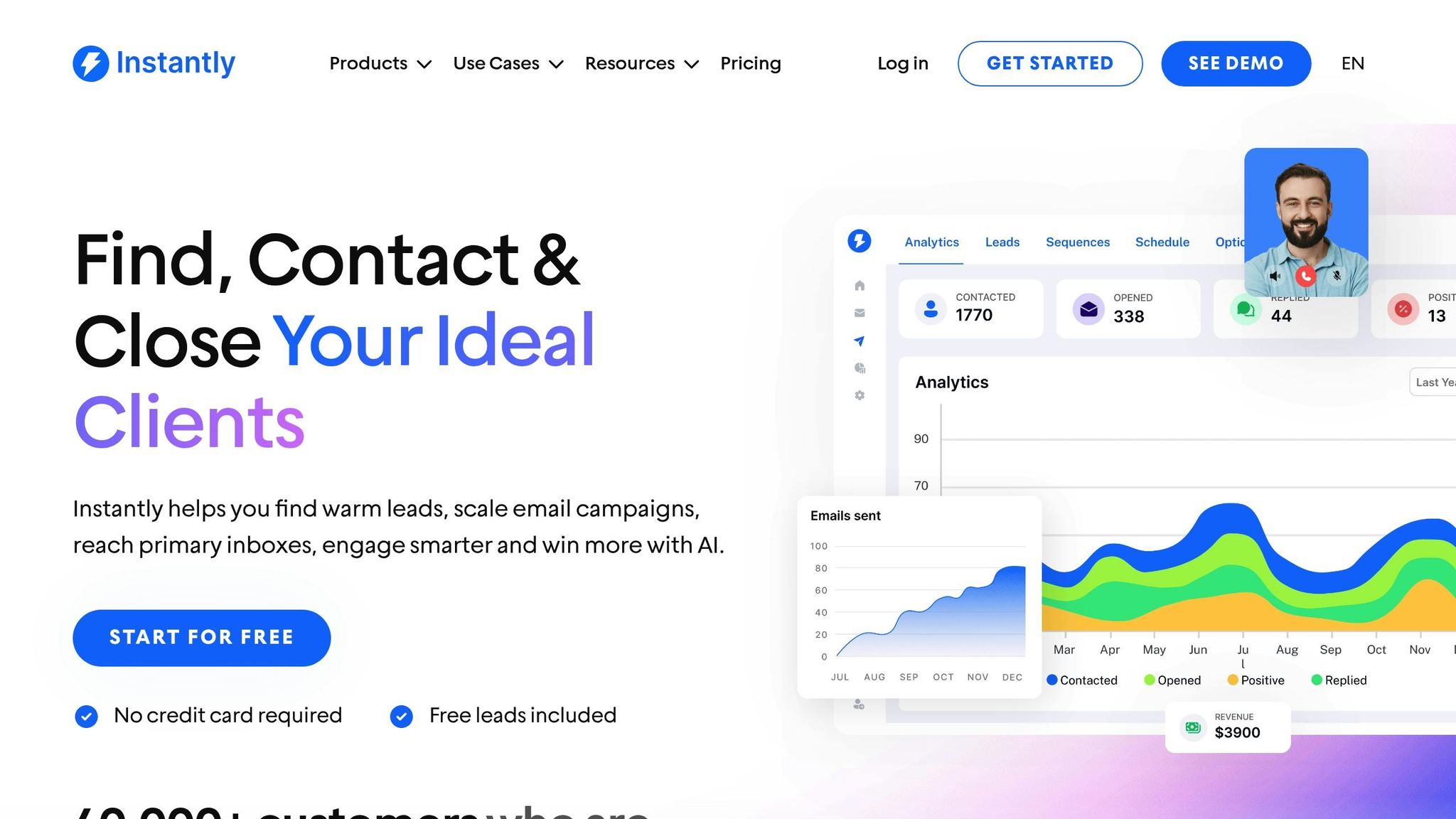
Instantly is a platform designed to improve email deliverability for high-volume cold email campaigns. It combines tools like email warm-up, verification, and placement testing to help sales teams and agencies maintain a solid sender reputation and hit their open rate goals.
Tools to Boost Deliverability
One of Instantly’s standout features is its automated warm-up sequences. These gradually increase email sending volume and engagement, helping to establish sender credibility. The platform uses rule-based warm-up processes with inbox rotation and spam trap monitoring to protect sender reputation. Additional features include email list verification, domain health checks, and placement testing. However, its placement testing isn’t as detailed as Warmforge’s AI-powered approach. Together, these tools make Instantly a strong choice for managing high-volume outreach campaigns.
Pricing (USD)
As of 2026, Instantly offers tiered pricing to meet the needs of different users. The Starter plan is priced at about $37 per month, the Growth plan at $97 per month, and the Pro plan at $197 per month. There’s also an Enterprise plan with custom pricing for larger organizations. While the Starter plan might include more features than necessary for small businesses, it’s worth noting that Warmforge offers free warm-up and placement test options, which could be a better fit for those on a tighter budget. Instantly’s pricing structure is designed to accommodate everyone from startups to large enterprises.
Integration Capabilities
Instantly works seamlessly with major email providers like Gmail, Outlook, Google Workspace, and Microsoft 365. It also integrates with popular CRMs and outreach platforms such as HubSpot, Salesforce, and Pipedrive, making it easy to incorporate into existing workflows. For teams needing custom solutions, Instantly provides API access and works with automation tools like Zapier. On the other hand, Warmforge offers native integrations within The Forge Stack, connecting with tools like Salesforge, Mailforge, Infraforge, Primeforge, and Leadsforge, which is ideal for teams using a full-stack approach to sales and marketing.
Who Instantly Is For
Instantly caters to sales teams, agencies, and B2B marketers focused on high-volume cold email campaigns. Maintaining a strong sender reputation is crucial for these users. Typical use cases include lead generation, appointment setting, and SaaS sales, where consistent open rates can directly affect revenue. E-commerce and affiliate marketers also benefit from Instantly’s tools, as they help prevent emails from landing in spam folders when sending in large volumes.
In 2026, open rate expectations for Instantly users depend on the industry. B2B and SaaS campaigns generally see open rates between 38% and 43%, while e-commerce campaigns average around 31% to 38.6%. Meanwhile, sectors like non-profits and education can achieve open rates of 45% or more, thanks to higher engagement levels. Instantly is particularly suited for teams that value structured warm-up processes and reliable volume management.
Pros and Cons
Choosing the right email deliverability tool can make or break your chances of hitting 2026's benchmark open rate of 42.35%. Each platform offers distinct advantages and trade-offs, from pricing to features. Below is a breakdown of Warmforge, Mailwarm, Folderly, and Instantly to help you improve open rates and inbox placement.
| Tool | Pros | Cons | Pricing (USD) | Best For |
|---|---|---|---|---|
| Warmforge | - AI-powered warm-up that simulates human behavior (opens, replies, spam removal) - Includes deliverability monitoring, placement tests, and health checks (DNS/MX records, blacklist scanning) - Free initial testing to measure results - Integrates natively with The Forge Stack for full outreach management |
- Requires separate subscriptions for other Forge Stack tools, raising costs - Broader ecosystem may feel complex for users needing just basic warm-up - Limited benefits for non-Google or Microsoft mailbox users |
Around $3–$12 per mailbox/month (varies by billing cycle and volume) | U.S.-based B2B SaaS teams, agencies managing multiple clients, and sales teams needing diagnostics and outreach tools |
| Mailwarm | - Simple warm-up tool that gradually increases sending volume via real mailbox interactions - Easy setup for Gmail, Outlook, and other SMTP providers - Affordable entry-level solution for reputation building |
- Lacks advanced diagnostics like DNS checks or spam trigger analysis - Becomes less cost-effective for larger operations |
Tiered per-mailbox pricing (varies by plan) | Solo cold outreach senders, small sales teams, and startups focused on reputation building |
| Folderly | - Comprehensive platform offering spam audits, DNS setup guidance, and spam diagnostics - Consulting support with detailed inbox placement and reputation reporting - Addresses deeper deliverability issues to boost open rates |
- Premium pricing may deter smaller teams - Advanced features might exceed needs for simple warm-up tasks - Setup can be time-intensive due to detailed analysis |
Premium per-mailbox pricing (higher than basic tools) | B2B service providers, SaaS companies, and agencies with complex deliverability needs aiming to raise open rates significantly |
| Instantly | - Combines warm-up with campaign management, multi-inbox rotation, and lead tracking - All-in-one platform for outreach and warm-up - Designed for high-volume campaigns |
- Warm-up is secondary to broader campaign management, with fewer diagnostics - Account-based pricing can get expensive for larger teams needing more features |
Account-based pricing (varies by features and mailbox count) | Sales teams, agencies, and B2B marketers running high-volume cold email campaigns who want an integrated solution |
These tools can transform email campaigns when used effectively. For example, a U.S.-based B2B SaaS team with open rates stuck at 20–25% could see improvements by leveraging Warmforge's AI-driven warm-up and placement tests. On the other hand, an ecommerce brand aiming to reach the retail average open rate of 37.5% might benefit from Folderly's in-depth diagnostics to fix technical issues.
Pricing differences can directly impact lead generation. For instance, increasing a B2B campaign's open rate from 25% to 40% could raise qualified leads from 50 to 80 per 1,000 emails. In industries like retail or ecommerce, where average click rates hover around 2.0–2.1%, better inbox placement translates to more sales and conversions.
Integration is another key factor. Warmforge works seamlessly with The Forge Stack, making it ideal for teams already using related tools. Instantly, on the other hand, integrates with CRMs like HubSpot, Salesforce, and Pipedrive, allowing sales teams to incorporate warm-up directly into their workflows.
Ultimately, your choice depends on your team size, email volume, industry, and budget. Warmforge and Folderly are great for teams needing both warm-up and detailed diagnostics. Mailwarm offers a straightforward, affordable option for smaller teams, while Instantly caters to high-volume senders seeking an all-in-one solution.
Conclusion
Reaching open rates of 42–43% by 2026 demands a solid deliverability setup, smart tool choices, and consistent performance tracking. For U.S. teams struggling to meet industry benchmarks, the first step should be diagnosing inbox placement issues. For instance, if a B2B SaaS team notices significantly lower open rates compared to their peers, the root cause is often tied to deliverability challenges rather than the quality of their email content. Addressing these foundational issues is crucial before selecting the right tools to optimize performance.
When it comes to tools, Warmforge stands out as a top pick for cold outreach and building mailbox reputation. Its AI-powered warm-up process simulates human email activity, while placement tests help identify whether Gmail or Outlook is categorizing emails as spam or promotions. Real-time health checks ensure DNS records and blacklist statuses are in good shape. Plus, its free warm-up and placement test options make it an accessible choice for smaller U.S. teams looking to validate results before scaling. For organizations already using The Forge Stack, Warmforge acts as the reputation and deliverability layer to ensure emails consistently land in primary inboxes.
Mailwarm is ideal for solo entrepreneurs and small businesses seeking a straightforward warm-up solution. On the other hand, Folderly caters to large enterprises needing in-depth deliverability repairs. Companies with multiple brands, complex email setups, or a history of blacklisting benefit from Folderly’s detailed audits, domain and IP reputation analysis, and hands-on remediation services. For outbound-focused teams and agencies managing high-volume campaigns, Instantly provides integrated prospecting and sending tools, though its warm-up features are secondary to its campaign management capabilities.
To maximize results, tailor your approach based on your organization’s size and needs. U.S. teams should use industry-specific benchmarks as a guide - e-commerce typically sees open rates in the low-30% range, while nonprofits and education often achieve mid-40% to low-50%. Keep an eye on trends over time instead of chasing a single universal target. Pair open rates with metrics like click-through rate (CTR) and click-to-open rate (CTOR) for a fuller picture of engagement, especially since privacy features like Apple Mail Privacy Protection can inflate open numbers. A quarterly review process works well: compare your performance against industry data, run placement tests, adjust warm-up strategies, prune low-performing mailboxes, and experiment with subject lines and send times (studies often recommend sending around 8:00–9:00 a.m. local time for better engagement). Standardizing a dashboard to track open rates, inbox placement, and domain reputation is also key.
For small U.S. startups, Warmforge is a great choice to safely warm up 1–3 Google or Microsoft mailboxes while ensuring primary inbox placement. Mid-sized SaaS or e-commerce teams can integrate Warmforge with their CRM to continuously monitor and warm new sales or lifecycle mailboxes, layering in Instantly for high-volume outbound campaigns if needed. Large enterprises managing multiple brands or dealing with regulatory challenges may benefit from Folderly’s deliverability solutions, followed by Warmforge for ongoing mailbox monitoring and warm-up.
Ultimately, the right tool depends on your team’s size, email volume, industry, and budget. Deliverability isn’t a one-time fix - it’s an ongoing process. Whether you’re a solo founder warming your first mailbox or part of a Fortune 500 marketing team managing dozens of domains, combining strong infrastructure, strategic warm-up methods, and regular placement testing can help push your open rates from below average to consistently above industry benchmarks.
FAQs
How do updates like Apple Mail Privacy Protection affect email open rate accuracy in 2026?
Privacy updates, like Apple Mail Privacy Protection, have changed the game for email marketers. By blocking tracking pixels and preloading email content, these updates have made open rates far less dependable. The result? Inflated numbers that don’t always represent real user engagement.
To navigate this shift, many marketers are turning to other metrics to gauge success. Click-through rates, conversion rates, and reply rates are becoming the go-to indicators for measuring how well campaigns perform. Tools such as Warmforge can also play a key role, helping improve email deliverability and engagement. They can ensure your messages land in the primary inbox, keeping your sender reputation intact amid these evolving challenges.
How does Warmforge compare to other email deliverability tools in features and pricing?
Warmforge takes email deliverability to the next level by leveraging AI to handle email warm-up, monitor deliverability, and conduct placement tests. This ensures your emails don't just get sent - they land in the primary inbox, where they belong. By simulating human-like behavior, Warmforge enhances sender reputation and boosts the success of your outreach efforts. Some standout features include automated warm-up, regular health checks, and free monthly placement tests to keep your email campaigns on track.
What sets Warmforge apart is its pricing approach. Instead of locking users into subscription plans like many competitors, it offers a flexible model based on mailbox slots. Plus, new users can test the waters with one free warm-up slot for a Google or Microsoft mailbox. This makes it a smart and budget-friendly option for improving email deliverability.
Why should marketers prioritize click-through rates and inbox placement over open rates?
When it comes to evaluating email performance, open rates are just the tip of the iceberg. To gain a clearer picture of how your emails are performing, you’ll want to pay attention to metrics like click-through rate (CTR) and inbox placement. CTR reveals how effectively your content engages recipients, showing whether they’re clicking on your links. Inbox placement, on the other hand, is all about ensuring your emails make it to the primary inbox instead of getting lost in the spam folder.
Using tools like Warmforge can make a big difference in improving these metrics. They help boost email deliverability, safeguard your sender reputation, and ensure your messages land where they’re most likely to grab attention and drive action.