Most cold emails get ignored, not because the offer is bad, but because the email reads like it was sent to 5,000 people at once.
I have written and tested cold emails for years. The pattern almost never changes. The ones that get replies feel personal, make one clear point, and ask for something small. The ones that get deleted are long, self-centered, and stuffed with filler.
So if you want to know how to write a cold email that actually gets a reply, here is the short version.
That is the entire game. But each step has a craft to it, and getting them right is what separates a reply from a delete.
The rest of this guide walks through every part with examples you can copy.
I also cover the pieces most advice skips: frameworks, timing, personalization at scale, and metrics. Plus the deliverability foundation that decides whether anyone sees your email at all.
Let's get into it!
Before the how, here is the what.
A good cold email has six parts. Getting each one right covers most of what makes a reader respond.
The mistake I see most often is treating the email like a pitch deck. A cold email is not a place to explain everything. It is a place to start a conversation.
Keep that idea in your head, because it shapes every decision that follows.
Since this whole article is about improving them, it is worth being clear on what a cold email actually is.
A cold email is a message you send to someone who does not know you. There is no prior relationship and no opt-in. You found them, decided they were a good fit, and reached out first.
That makes it different from spam, even though people confuse the two. Spam is irrelevant and sent in bulk with no thought.
A good cold email is targeted, relevant, and written for one specific person. The difference is intent and effort, and your reader can feel which one they are looking at within the first line.
People use cold emails for sales, hiring, partnerships, fundraising, and job hunting. The structure barely changes across those uses. What changes is the ask. That means once you learn to write one well, you can write all of them.
So why do so many of them fail? The reasons are predictable.
If you know why cold emails fail, you can write one that does the opposite. Most of them die for the same handful of reasons.
Every step below is designed to solve one of those four problems. Let me show you how, starting from the moment you sit down to write.
Here is the process I follow. Work through it in order the first few times. After that it becomes second nature.
Everything good in a cold email starts here.
Personalization is not pasting a first name into a template. It is proof that you know who you are writing to.
Before I write anything, I look for one specific, true detail about the person or their company. It could be a recent product launch, a role change, or a post they wrote. Even a problem their industry is dealing with right now works.
That one detail becomes the hook for the whole email. Without it, you are writing a generic message and hoping. With it, you have an actual reason to be in their inbox.
Spend two minutes here. It is the highest-leverage part of the whole email, and it feeds directly into the next step.
Once you know your hook, the subject line is where you use it first.
If the subject line fails, nothing else matters. The reader never sees the body you worked on.
The best cold email subject lines are short, specific, and curious without being clickbait. They read like something a colleague would send, not a marketing campaign. Here are a few patterns that work:
Avoid all caps, exclamation points, and salesy phrases like "limited time" or "act now." Those hurt your open rate and trip spam filters at the same time.
Keep it under five words when you can. Short subject lines look personal, and long ones look automated. Once the subject line earns the open, the first line has to keep the reader there.
The first line decides whether the reader keeps going. Most people waste it by introducing themselves.
"My name is X and I work at Y" tells the reader nothing they care about. Lead with the detail you found in Step 1 instead.
Compare these two openers:
Weak: "Hi Sarah, my name is Anil and I am a sales manager at a software company."
Strong: "Hi Sarah, saw that your team doubled headcount last quarter. That usually breaks the old onboarding process fast."
The second one shows you paid attention, and it sets up the problem you are about to help with. With the reader leaning in, now you can make your point.
This is where you connect their situation to your reason for writing. Brevity is everything here. Keep it to two or three sentences.
Do not list every feature or every service you offer. Pick the one thing that matters to this person and lead with the outcome, not the mechanics.
A simple formula works well. Name the problem, then name the result you help people get.
"Most teams in your spot end up onboarding new reps by hand, which slows everyone down. I help sales teams cut that ramp time roughly in half."
That is enough. You are not trying to close the deal in the email. You are trying to earn a reply.
The call to action is where most cold emails fall apart. They ask for too much, too soon.
"Can we book a 30-minute demo this week?" is a heavy lift for someone who just met you. A smaller ask gets a higher reply rate every time. Try one of these instead:
One ask, phrased as a yes-or-no question. Make it easy for a busy person to reply with a single word.
By now your email has a job to do, and length is its enemy.
A cold email should fit on a phone screen without scrolling. Aim for 50 to 125 words total. Anything longer and you are asking for more attention than a stranger will give.
Use short sentences. Use line breaks. Write the way you talk.
Your sign-off should look like a real person sent it. Your name, your role, and one link if it is relevant. Skip the giant signature block with five social icons and a banner. It looks like marketing and undoes the personal tone you just built.
Most replies do not come from the first email. They come from the second and third.
People are busy. Your first email gets buried. A short, polite follow-up a few days later puts you back at the top of the inbox without being annoying.
Keep follow-ups even shorter than the original. Reference the first email, add one new angle, and ask again.
"Hi Sarah, floating this back up in case it got buried. Happy to send that breakdown over if it is useful."
Two to three follow-ups, spaced a few days apart, is the sweet spot. After that, move on.
Those seven steps are the backbone. If you want to write them faster, a few proven frameworks make the body almost write itself.
When you are staring at a blank email, a framework gives you a structure to fill in. I keep coming back to three, and each one fits a different situation.
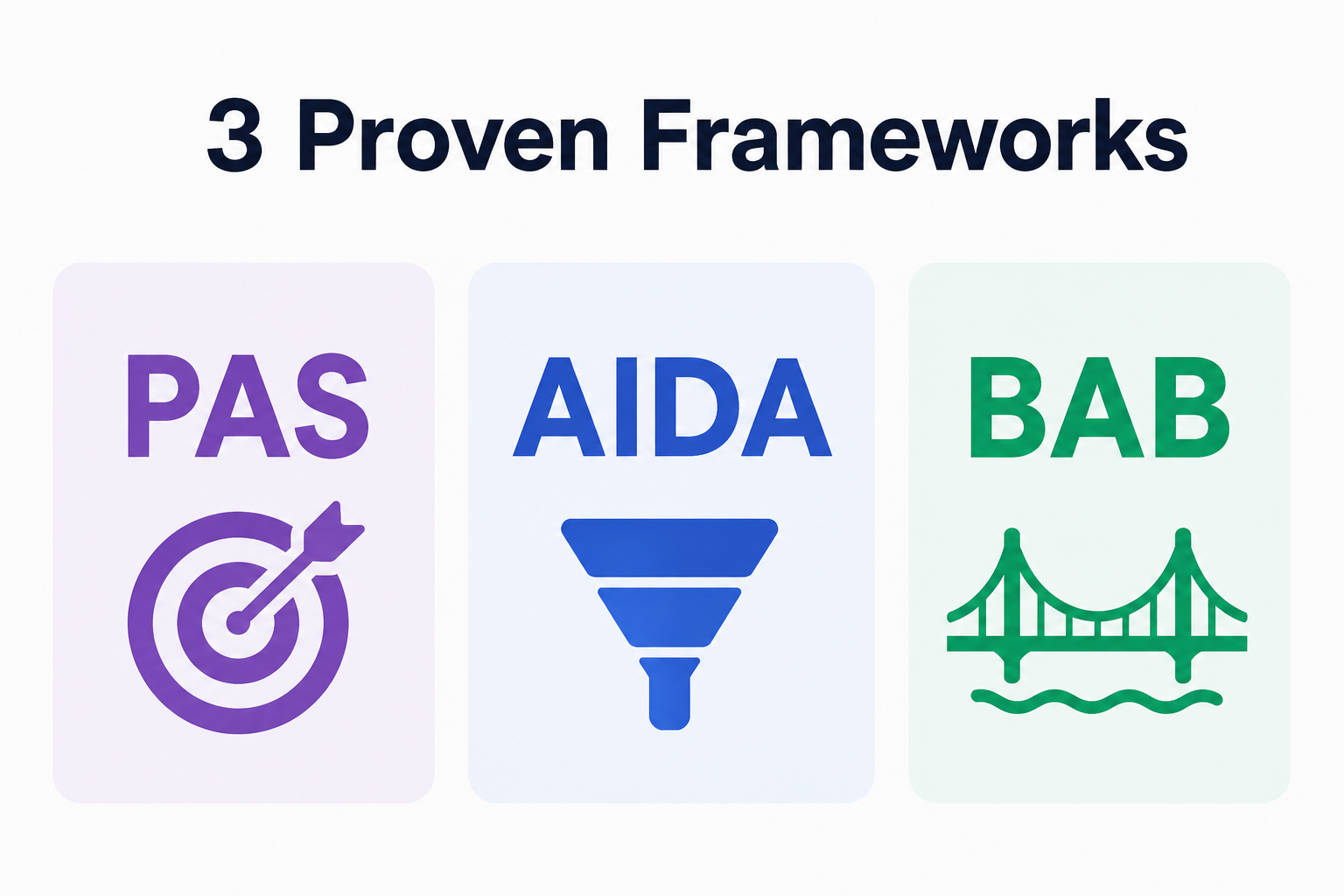
You name the reader's problem, briefly show why it stings, then offer your solution. It works well when the reader already feels the pain.
"Hiring fast is great until onboarding falls apart. New reps take months to ramp, and the whole team feels the drag. I help teams cut that ramp time in half."
You grab attention with the opener, build interest with a relevant detail, create desire with the outcome, then ask for the next step. It suits readers who do not yet know they have a problem worth solving.
You describe their world now, paint the better version, then position yourself as the bridge. It is a clean way to sell an outcome without sounding pushy.
None of these are rules. They are scaffolding. Pick the one that matches how aware your reader is of the problem, and the words come faster.
Frameworks shape the words, but examples show you the finished product.
Templates are a starting point, not a finished email. Swap in real details before you send. Here are five that cover the most common situations.
Example 1: Cold Sales Email (B2B)
Subject: Idea for [Company]'s onboarding
Hi [First name],
Saw [Company] grew the sales team fast this year. That usually breaks the old onboarding process and reps take longer to ramp.
I help B2B sales teams cut new-rep ramp time roughly in half with a simpler onboarding flow.
Worth a quick look?
[Your name] [Role, Company]
Example 2: Cold Email for a Job
Subject: Quick question about your design team
Hi [First name],
I have followed [Company]'s product work for a while, and the recent redesign really stood out to me.
I am a product designer with five years in fintech. I would love to be considered if your team is growing.
Would it be alright to send over my portfolio?
[Your name]
Example 3: Partnership or Link Outreach
Subject: Your guide on [topic]
Hi [First name],
Your guide on [topic] is one of the clearest I have read. I just published a piece with original data on the same subject that your readers might find useful.
Happy to send it over if you want to take a look.
[Your name] [Role, Company]
Example 4: Cold Email to an Investor
Subject: [Company] traction update
Hi [First name],
I saw you invested in [Portfolio company], which is solving a problem close to ours.
I have seen 3x revenue growth in the last six months in the same space, and I am starting to raise.
Open to a quick intro call?
[Your name] [Role, Company]
Example 5: Follow-Up Email
Subject: Re: Idea for [Company]'s onboarding
Hi [First name],
Floating this back up in case it got buried. No worries if the timing is off.
If it helps, I can send a two-minute breakdown of how teams your size are handling this.
[Your name]
For more examples of personalized cold emails that actually convert, I put together a separate breakdown worth reading.
Examples only work if they reach the right person at the right moment. Timing matters more than most people think.
You can write a perfect email and still lose the reply by sending it at the wrong moment.
In my experience, mid-morning on a weekday tends to land best. That is after the early inbox rush has cleared but before the afternoon gets busy. Tuesday through Thursday usually beats Monday and Friday, when people are either catching up or checking out.
Time zones matter as much as the clock. Sending at 10 a.m. does nothing if your reader is three hours behind and still asleep. Send based on their local time, not yours.
None of this is a hard law. Your audience may behave differently. The only way to know for sure is to test send times against your own reply data.
The harder question is how to stay personal when you are writing to more than one person.
Writing one personal email is easy. Writing a hundred that still feel personal is the real challenge, and it is where most outreach breaks down.
The trick is to separate what changes from what stays the same. The frame of your email, the structure and the offer, stays constant. The hook, that one specific detail from Step 1, changes for each person.
So instead of writing a fresh email every time, I write a strong frame once and swap the hook per recipient. Group similar prospects together by role, industry, or the problem they share. A single well-built frame can serve a whole segment with only the opening line changing.
That is the point where doing it by hand stops scaling. Researching one detail for ten people is fine. Doing it for five hundred is a full-time job.
Here is the part most personalization advice skips. The moment you start sending at volume, your deliverability becomes the bottleneck. It does not matter how personal your emails are if your mailboxes are not warmed up and monitored before you scale. I have seen teams write great copy, build great lists, and still get zero replies because they skipped the infrastructure step.
Once you are sending at that volume, you also need a way to know whether any of it is working.
Writing a great email is only half the job. The other half is reading the numbers it sends back.
Four metrics tell you almost everything.
Watch these together and they tell a story. Low opens point to the subject line or sender reputation. Good opens but low replies point to the body. High bounces point to the list. Fix the metric that is broken instead of rewriting everything at once.
And bounces lead straight to the problem most writing guides ignore entirely.
Before I get to deliverability, here are the most common failures in one place. I have seen each of these sink an otherwise good campaign.
You can write the best cold email in the world. If it lands in the spam folder, none of it matters.
Most advice about how to write a cold email skips this part entirely. But deliverability is the difference between a campaign that works and one that quietly fails.
It comes down to a few things.
You need to send from a warmed-up inbox, so your domain has a sending history before you start outreach.
You should not blast too many emails at once, because sudden volume looks like spam to mail providers. You have to keep your copy clean of spam trigger words. And you need to remove invalid addresses before you send, so your bounce rate stays low and your sender reputation stays protected.
I run every new sending domain through Warmforge for at least 14 days before a single cold email goes out. The warmup process uses AI-generated emails that mimic real inbox conversations, which builds trust with providers like Google and Microsoft. While the domain warms up, I run placement tests. They show me exactly where my emails land: primary inbox, promotions, or spam.
The Heat Score inside Warmforge tells me when a mailbox is actually ready to send. If a mailbox drops below 85, I know something needs attention before I scale. That kind of visibility is the difference between guessing and knowing.
If you only send a handful of emails by hand each week, you can manage warmup manually. But once you go past that, it becomes a real job on its own.
When you send more than a few emails a week, doing everything by hand stops being realistic.
The deliverability piece is where I start. Warmforge handles the warmup, inbox placement monitoring, and DNS and blacklist checks. It also tracks mailbox health over time so your sending accounts stay ready. That is the foundation. Without it, even great copy goes nowhere.
Once your mailboxes are warm and healthy, you need a way to actually send sequences, test subject lines, and automate follow-ups. That is where Salesforge comes in. It handles multi-channel outreach across email and LinkedIn, with A/Z variant testing and automated follow-up sequences.
The workflow I follow: set up sending domains, warm them with Warmforge, confirm inbox placement, then build and launch sequences through Salesforge. The whole stack connects, so I am not juggling separate tools that do not talk to each other.
You can write a cold email in any inbox. A tool just makes it repeatable, testable, and safe to scale.
Writing a cold email that gets replies is not about clever tricks. It is about respect for the reader's time.
Do the research. Lead with them. Make one clear point. Ask for something small. Keep it short. Follow up. Do those six things consistently, and the frameworks, timing, and metrics covered above turn a good email into a repeatable system.
But none of it works if your emails never reach the inbox. That is why the deliverability piece is not optional. Warm up your domain before you start. Monitor your inbox placement while you send. Treat sender reputation as seriously as you treat your copy.
Start with one email today. Use the examples above, swap in real details, and send it. The skill builds fast once you stop blasting and start writing to one person at a time.
Aim for 50 to 125 words. A cold email should fit on a phone screen without scrolling. Shorter emails get higher reply rates because they respect the reader's time and feel personal rather than automated.
The best subject lines are short, specific, and curious without being clickbait. Three to five words works well. Tie it to something real about the reader, like a recent project or a clear question. Avoid salesy phrases that trigger spam filters.
Two to three follow-ups, spaced a few days apart, is the sweet spot. Most replies come from the second or third email, not the first. Keep each follow-up shorter than the last and stop once you have made your point.
In most regions, yes, as long as you follow the rules. In the US, the CAN-SPAM Act requires a real sender identity, a clear way to opt out, and an honest subject line. In the EU and UK, GDPR rules apply. Check the regulations for your region and your recipients before you send.
Use the same structure as a sales email. Open with a specific reason you admire the company. Briefly state your relevant experience. Make a small ask, such as permission to send your portfolio. Keep it short and skip the long cover-letter format.
A cold email is targeted, relevant, and written for one specific person with a genuine reason for reaching out. Spam is irrelevant, sent in bulk with no thought, and offers no real value. Intent and effort are what separate the two.
Reply rates vary widely by industry and targeting quality. A reply rate in the low single digits is common for cold outreach. Anything above that signals strong targeting and copy. Track your own baseline first, then work to beat it.
Yes. Sending cold emails from a fresh or inactive inbox is one of the fastest ways to land in spam. Warm up your mailbox for at least 14 days before sending outreach, and keep warmup running even after campaigns go live. Warmforge automates this process and monitors mailbox health so you know when you are actually ready to send.