Every email you send comes with legal and ethical responsibilities. Mismanaging data in email marketing can lead to severe consequences, including hefty fines, damaged sender reputation, and loss of customer trust. Here's what you need to know:
Failing to prioritize data privacy can cripple your campaigns, but following these guidelines ensures compliance, protects your brand, and keeps your emails in inboxes.

Email Privacy Law Compliance Requirements and Penalties Comparison
Before diving into email campaigns, it's crucial to understand the legal rules that govern data privacy. These laws vary based on where your subscribers are located, and breaking them can lead to hefty fines and serious damage to your business operations. Together, these regulations create a framework for ethical and secure email marketing practices. Adhering to these standards is also a key factor in how sender reputation impacts deliverability over time.
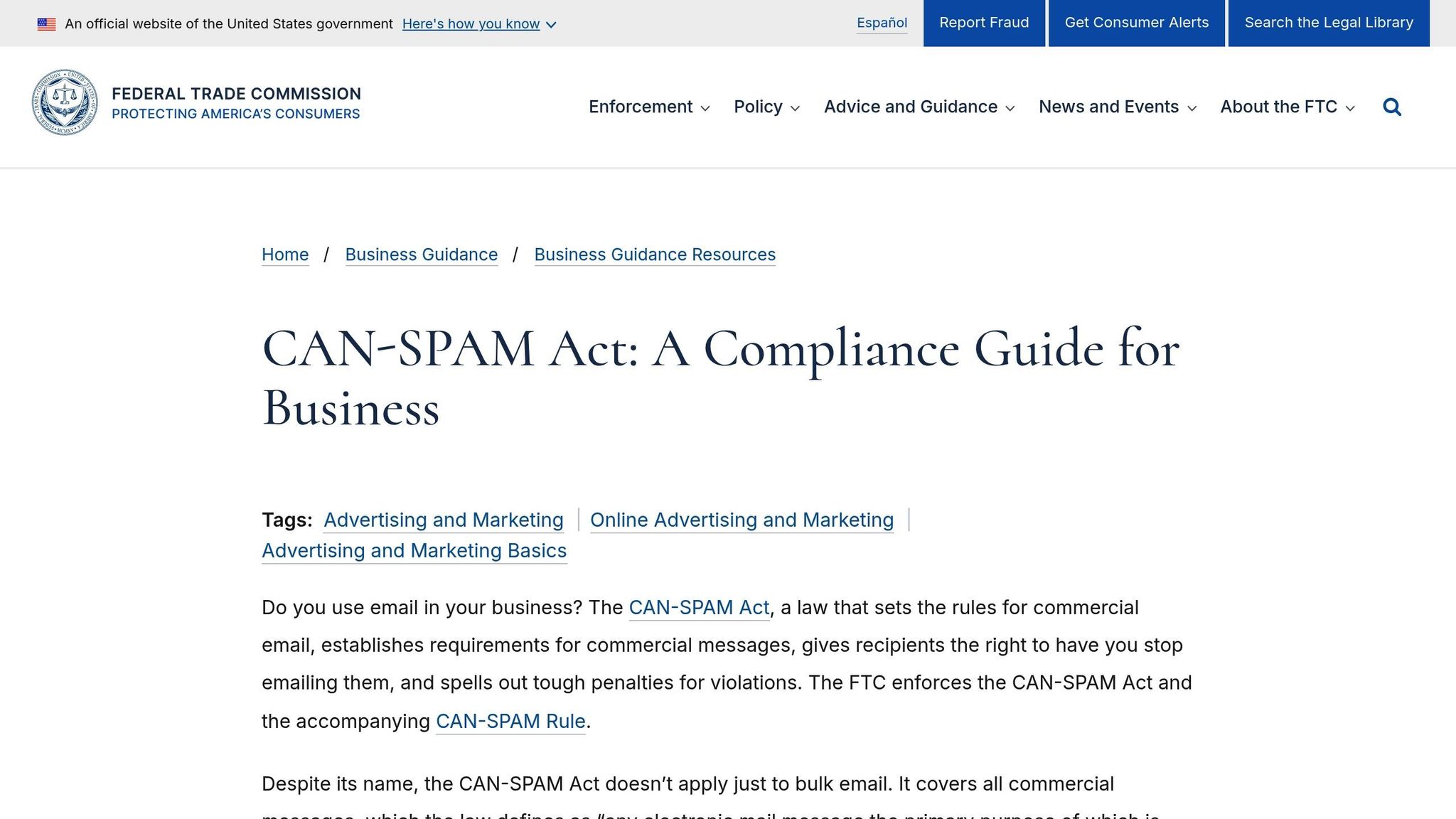
The CAN-SPAM Act is the primary federal law governing commercial emails in the United States. It applies to all commercial messages, whether you're sending a single email or a large-scale campaign, and even covers business-to-business communications. To comply, ensure your headers, subject lines, and reply-to information accurately reflect your business. Additionally, every email must include a valid physical postal address - this can be a street address, a registered P.O. box, or a private mailbox.
"The law makes clear that even if you hire another company to handle your email marketing, you can't contract away your legal responsibility to comply with the law." - Federal Trade Commission
Every email must also feature a clear, functional opt-out link that remains active for at least 30 days after the email is sent. If a subscriber opts out, you are required to honor their request within 10 business days. You cannot charge fees, ask for unnecessary information beyond their email address, or make them navigate multiple pages to unsubscribe. Severe violations, such as harvesting email addresses or using dictionary attacks, can even result in criminal penalties, including jail time.
The California Consumer Privacy Act (CCPA) adds additional requirements for businesses operating in California. It applies to companies with annual gross revenues of $25.625 million or more (effective January 1, 2025), those that handle data for 100,000+ California residents, or those deriving at least 50% of their revenue from selling or sharing personal information. Under the CCPA, California residents have rights that include knowing what data you collect, requesting deletion of their personal information, opting out of data sales or sharing, correcting inaccuracies, and limiting the use of sensitive information. Email content is considered sensitive unless it serves a strictly business-related purpose.
CCPA requests must be addressed within 15 business days, and businesses must also recognize Global Privacy Control (GPC) signals as valid opt-out requests. Non-compliance can be costly: each CAN-SPAM violation can result in fines of up to $53,088 per email. Meanwhile, CCPA penalties include fines of $2,500 per unintentional violation and $7,500 per intentional violation, with data breach lawsuits potentially costing $100 to $750 per consumer per incident. Businesses are given a 30-day cure period to address CCPA violations once notified.
The General Data Protection Regulation (GDPR) applies to all EU residents on your email list, regardless of where your business is located. Unlike U.S. laws like CAN-SPAM, which operate on an opt-out basis, GDPR requires opt-in consent. This means subscribers must actively agree to receive your emails before you can send them.
GDPR grants EU residents extensive rights, including access to their data, the ability to correct inaccuracies, the right to have their data deleted (known as the "right to be forgotten"), data portability, and the option to object to data processing. Businesses must respond to these requests promptly and keep detailed records of consent. If a data breach occurs, you are required to notify the appropriate authorities and affected individuals within 72 hours.
The penalties for GDPR violations are steep. Fines can reach €20 million or 4% of your company's global annual revenue, whichever is higher. Regulators have enforced these rules aggressively, with companies like Google, Amazon, and Meta facing penalties in the hundreds of millions. EU residents also have the right to seek compensation for damages caused by non-compliance.
For email marketers, GDPR emphasizes "privacy by design." This means embedding data protection into every aspect of your campaigns from the outset. It involves limiting data collection to what's absolutely necessary, encrypting subscriber information, and maintaining clear privacy policies that explain how personal data is used.
Keeping subscriber data secure is essential - not just for compliance but also to build trust with your audience and protect your business's reputation. Implementing strong security measures can help you achieve this.
Start by encrypting your data. Use AES-256 for stored data and TLS v1.2 or higher for data in transit. Avoid outdated protocols like SSL. To prevent email spoofing, configure SPF, DKIM, and DMARC to verify sender identity. Access to sensitive data should be tightly controlled with Role-Based Access Control (RBAC) and multi-factor authentication (MFA), ensuring only essential personnel have access.
For API security, use keys with limited permissions and rotate them every 90 days. Store encryption keys separately from the data they protect - preferably with Hardware Security Modules (HSMs) for secure key management.
Beyond technical safeguards, reducing the amount of data you collect and retain can significantly lower risks.
Only collect the data you truly need and set strict limits on how long you keep it. Holding personal information indefinitely "just in case" increases security risks and may violate regulations like GDPR.
"You must not hold personal information indefinitely, 'just in case' it might be useful in the future."
– Information Commissioner's Office (ICO)
Automate processes to delete or anonymize data once retention periods expire. For example, define an inactivity threshold - like 180 days without an email open or click - and regularly purge inactive subscribers. Before full deletion, consider moving these subscribers to a suppression list temporarily. Maintain detailed audit logs to document these actions and ensure compliance.
While technical controls and data policies are critical, regular system reviews are just as important.
Conduct frequent security audits to check data access logs, validate SSL certificates, and update encryption policies. Ensure that deletion policies are synchronized across all connected systems - such as CRMs, lead generation tools, and email platforms - to avoid lingering copies of data.
When using third-party email tools, assess their data privacy practices thoroughly. Ask about their encryption methods, data storage locations, access controls, and compliance certifications. Review their privacy policies to understand how they handle subscriber data and whether they share it with others.
Some platforms, like Warmforge, focus on both deliverability and data security, helping you maintain a strong sender reputation while protecting subscriber information. Look for features like automated SSL certificates and domain masking to enhance security. For example, Mailforge offers these features at affordable rates - $2 per domain monthly or $6 annually.
Every part of your email marketing stack needs to meet high security standards because even a single weak link can jeopardize your entire data protection strategy.
Protecting subscriber data begins with how you handle consent. Doing this well not only ensures compliance but also strengthens trust with your audience.
Consent must be actively given through a clear affirmative action. This means using checkboxes that are unticked by default and presenting the consent request in simple, straightforward language, separate from general terms.
Make sure to provide separate consent options for different communication channels, like email and SMS. Be transparent - explain why you need their data, how you’ll use it, and identify your organization along with any third parties involved. Also, let subscribers know that withdrawing consent is just as easy as opting in.
"It must be as easy to withdraw as to give consent." – Information Commissioner's Office
Keep a record of each consent, including details like the subscriber’s information, the time and method of consent, and the terms agreed upon. If your data processing practices change, consider refreshing consent every two years. For existing customers, the "soft opt-in" rule allows you to market similar products without explicit consent, as long as their details were collected during a sale, the products are related, and you provide an opt-out option both at the time of collection and in every communication.
This structured approach ensures your consent practices align with broader goals of safeguarding email data and ensuring GDPR compliance for email tracking tools.
Effective consent management goes hand-in-hand with handling unsubscribe and data deletion requests. Under the CAN-SPAM Act, opt-out requests must be honored within 10 business days. For UK GDPR and PECR, automated systems must stop processing immediately.
| Requirement | CAN-SPAM Act (U.S.) | PECR / UK GDPR (UK) |
|---|---|---|
| Processing Timeline | Within 10 business days | Immediately |
| Cost to User | Free of charge | Free of charge |
| Login Required? | Prohibited | Prohibited |
| Ease of Withdrawal | Single page or reply email | As easy as giving consent |
Unsubscribing should be simple - ideally a one-click process - without requiring logins, fees, or any extra steps . Additionally, you cannot sell or transfer an email address, except to a service provider assisting with compliance. The unsubscribe mechanism must remain functional for at least 30 days after the email is sent.
For data deletion requests, UK GDPR gives you one calendar month to respond . Train your team to recognize deletion requests, whether they come verbally or in writing, and ensure they’re directed to the right department. If you’ve shared the data with third parties, notify them of the erasure unless doing so would require disproportionate effort . For backup systems where immediate deletion isn’t feasible, ensure the data is put "beyond use" until it’s eventually overwritten.
When it comes to email campaigns, safeguarding your sender reputation and adhering to privacy laws is non-negotiable. The right third-party tools play a key role in ensuring both compliance and data protection. In fact, using compliant tools not only protects sensitive information but also minimizes legal risks under privacy regulations like GDPR and CASL.
Look for platforms offering robust security features such as AES-256 encryption for data at rest, TLS 1.2+ for data in transit, Role-Based Access Control (RBAC), and Multi-Factor Authentication (MFA). It's also wise to request certifications like SOC 2 Type II or ISO 27001 and carefully review their Data Processing Agreements (DPAs).
To further secure your email campaigns, configure SPF, DKIM, and DMARC records to guard against spoofing. Automating DNS setups can help reduce errors. For API integrations, use keys with limited permissions and rotate them every 90 days to maintain security.
"The law makes clear that even if you hire another company to handle your email marketing, you can't contract away your legal responsibility to comply with the law." – Federal Trade Commission
Additionally, adopt data minimization practices like pseudonymization or tokenization, and automate deletion or anonymization of contacts who have been inactive for 180 days. Avoid risky features like incentivized "forward-to-a-friend" options, as these could unintentionally transfer compliance liability. These safeguards provide a solid foundation for evaluating tools that align with both your marketing and compliance goals.
The source of your subscriber data is just as important as the technical measures you implement. Purchased email lists are a major red flag under privacy laws because the individuals on these lists have not given explicit consent to receive your emails. Regulations like GDPR and PECR require clear, affirmative consent - pre-checked boxes or vague permissions simply don’t cut it.
Beyond the legal concerns, purchased lists can damage your email deliverability. These lists often include spam traps - email addresses used by organizations like Spamhaus to catch unauthorized email practices. Hitting one of these traps can get your domain blocklisted, effectively halting your emails from reaching inboxes.
The financial risks are also steep. Under GDPR, violations can result in fines up to €20 million or 4% of global revenue. In 2024 alone, fines tied to email marketing errors exceeded €1.6 billion. CASL penalties are similarly harsh, with fines reaching as high as $10 million. On top of that, mishandling data can erode trust - 66% of consumers say they’d stop supporting a company that misuses their information.
Focusing on data privacy doesn’t just help you stay compliant - it also improves your email deliverability. Tools like Warmforge can help by building a strong sender reputation through an automated domain warm-up process. This approach signals to ISPs that your emails are legitimate.
Warmforge gradually increases your sending volume over several weeks to mimic natural email activity, preventing new domains from being flagged as suspicious. The tool also monitors key metrics like email placement rates and domain authority, enabling you to address potential issues before they escalate into serious problems like blocklisting.
"Warmforge... focuses on optimizing deliverability by gradually warming up your domains and mailboxes. By building a positive sender reputation, it ensures your privacy-focused emails land where they're supposed to." – Mailforge Blog
Warmforge integrates seamlessly with services like Mailforge (around $3 per mailbox per month), Infraforge ($3–$4 per mailbox), and Salesforge. It automates SPF, DKIM, DMARC, and SSL configurations, reducing the risk of manual errors.
To make it easy to try, Warmforge offers one free warm-up slot for every user (for a Google or Microsoft mailbox) and one free placement test each month. Paid plans start at $9 per mailbox slot per month, with discounts bringing the price down to $3 per slot for bulk purchases.
Personalized, privacy-conscious emails consistently perform better, achieving a 29% higher open rate and a 22% increase in engagement. On the flip side, 68% of users actively avoid brands that send unsolicited or non-compliant emails. By maintaining a strong sender reputation, Warmforge ensures your emails reach engaged subscribers while keeping you on the right side of privacy laws.
"You can run a compliant email campaign without much trouble, as long as you fundamentally don't aggressively target individuals who have not expressed direct interest." – Alexander M. Kehoe, Co-founder and Operations Director, Caveni Digital Solutions
Choosing the right tools and strategies ensures you strike the perfect balance between email deliverability and data privacy, setting the stage for successful campaigns.
Prioritizing data privacy in email marketing does more than keep you on the right side of the law - it builds trust and delivers better results. Respecting subscriber preferences and handling data responsibly sends a clear message to both your audience and email service providers: you’re a trustworthy sender worth engaging with. And the stats make this clear: 89% of consumers care about data privacy and want more control over their information, while 68% avoid brands that send unsolicited or non-compliant emails.
The financial risks of non-compliance are no joke. Under GDPR, penalties can reach €20 million or 4% of global revenue, and CAN-SPAM violations can cost up to $53,088 per email. Compliance missteps have led to hefty enforcement actions, but companies that invest in secure systems report at least a 40% lower risk of privacy-related fines.
"Protecting customer data is not just about following the law – it's crucial for maintaining trust and ensuring your emails actually reach your audience." – SendLayer
Beyond avoiding fines, privacy-focused practices improve email deliverability. When spam complaints drop, your sender reputation with ISPs improves, leading to higher inbox placement rates. Practices like robust opt-ins, easy unsubscribe options, and regular list hygiene help maintain strong engagement metrics that signal to email providers your messages are wanted. Tools like Warmforge can support this by gradually building domain authority, leaving you free to focus on creating meaningful, consent-based campaigns.
The takeaway? Privacy isn’t just about staying compliant - it’s a competitive edge. By combining transparent policies, secure systems, and responsible practices, you’re not just avoiding penalties. You’re laying the groundwork for sustainable growth, built on trust and reliable inbox delivery.
The CAN-SPAM Act is a U.S. law designed to regulate commercial email practices. It requires businesses to follow specific rules, such as using accurate sender information, steering clear of misleading subject lines, clearly labeling emails as advertisements, including a valid physical address, and providing an easy opt-out option that must be processed within 10 business days.
In contrast, the GDPR applies across the EU and takes a broader approach, focusing on data protection and privacy. It stresses obtaining lawful consent, respecting individuals' rights (like accessing or deleting their data), limiting data use to defined purposes, and implementing strong security measures for personal data, including email addresses.
While both laws aim to safeguard individuals, their focus differs: CAN-SPAM zeroes in on email content and sender conduct, whereas GDPR addresses a wider range of data privacy and security responsibilities. Businesses operating globally may need to navigate and adhere to both sets of regulations.
To safeguard subscriber data, businesses must prioritize privacy throughout their email campaigns. Start by collecting only the essential information and obtaining clear, explicit consent from subscribers. Store this data in encrypted environments, such as those using AES-256, and ensure secure transmission methods like TLS 1.2 or higher are in place. To prevent email spoofing, implement authentication protocols such as SPF, DKIM, and DMARC. Access to sensitive data should be limited through role-based permissions and multi-factor authentication.
Maintaining security also requires regular audits, timely software updates, and thorough staff training on data handling. Platforms like Warmforge make this process easier by combining AI-driven email warm-up and deliverability tools with a secure infrastructure. Warmforge enforces encryption and authentication protocols while providing audit logs for added transparency. Unlike competitors like Mailgun or Mailchimp, Warmforge stands out by using AI to mimic human behavior, which improves deliverability and protects your sender reputation. Pairing robust policies with a secure platform like Warmforge allows businesses to protect subscriber data effectively while maintaining trust.
Using purchased email lists comes with serious legal and ethical challenges. Most of these email addresses are collected without the recipients' clear consent, which directly conflicts with privacy laws like the CAN-SPAM Act, GDPR, and CCPA. These regulations require businesses to have explicit permission before sending marketing emails. Ignoring this can result in hefty fines and a tarnished brand reputation.
But it’s not just about the legal risks - purchased lists rarely deliver good results. People are far less likely to engage with emails they didn’t sign up for, which can hurt your sender reputation and reduce your email deliverability. A better approach? Build your own list of subscribers who actually want to hear from you. Not only does this keep you on the right side of the law, but it also boosts the effectiveness of your email campaigns.